
Beyond OCR: Why Intelligent Submission Intake is the Foundation of AI-driven Insurance Operations
Blogs
Insurance operations run on documents.
Every quote submission, policy application, inspection report, medical record, repair estimate, claim form, broker email, and compliance document contains critical information needed to assess risk, service policies, and settle claims. However, nearly 80% of this information remains trapped in unstructured formats spread across underwriting workbenches, claims systems, policy administration platforms, email inboxes, and third-party data sources.
This creates persistent operational bottlenecks across the insurance value chain. Underwriters spend valuable time reviewing submissions and rekeying data from loss runs and financial statements. Claims teams face growing backlogs as adjusters manually validate documents, medical records, and repair estimates. Policy servicing teams struggle with fragmented customer information. Distribution channels contend with slow quote turnaround times and inconsistent submission processing.
For years, insurers have relied on OCR and workflow automation to digitize these processes. While these technologies improved data capture and task routing, they were never designed to understand context, make decisions, or coordinate actions across complex insurance operations.
As insurers pursue higher straight-through processing rates, faster underwriting decisions, improved claims outcomes, and better customer experiences, traditional automation is reaching its limits. What is needed is not simply better document capture, but a foundation for autonomous operations.
That foundation begins with intelligent submission intake and document intelligence.
The structural breakdown of standard OCR
Traditional OCR is fundamentally rigid. It relies on predefined layouts and fragile rule-based logic. The system is programmed to look for a specific data point, such as an "Accident Date" or "Policy Number", at an exact geometric coordinate on a page.
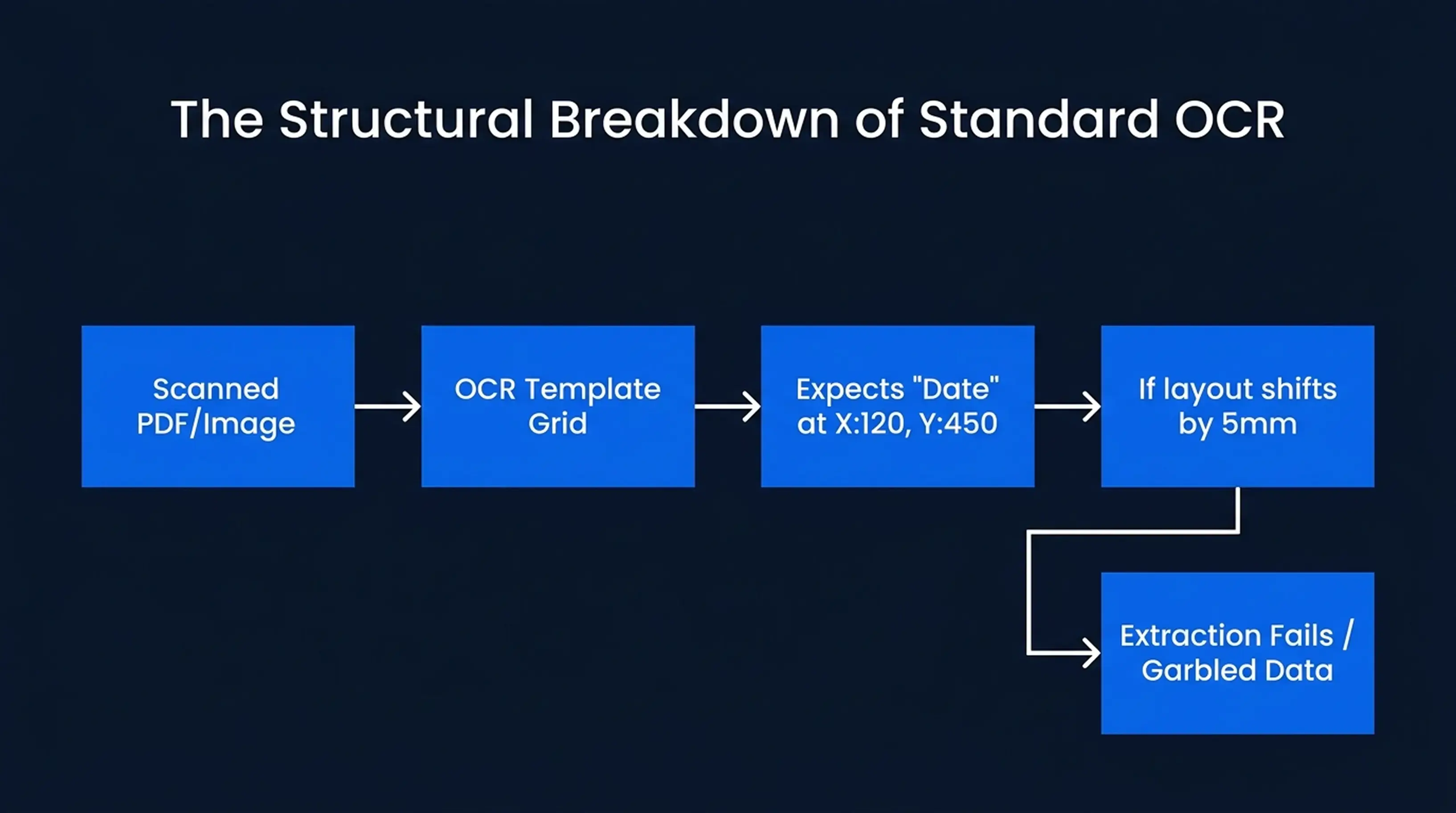
If a medical provider alters their billing layout, or if a First Notice of Loss (FNOL) form is scanned at a slight angle, the coordinate map breaks. The result is either a total extraction failure or worse, fragmented, uncontextualized data injected into core systems. This fragility forces a massive "human-in-the-loop" footprint, requiring claims adjusters and underwriters to manually review, correct, and map data into legacy core platforms.
Furthermore, traditional OCR cannot handle semantic variability. It can extract the string "10/12/2025" but cannot inherently deduce whether that date represents the policy inception, the date of clinical diagnosis, or the date of an automobile accident without explicit, custom code.
In contrast, modern submission intake solutions treat document processing not as a standalone capture task, but as the starting point for intelligent insurance operations. By understanding, classifying, validating, and routing information from submissions and supporting documents, these solutions transform unstructured information into actionable business intelligence.
The limitations of OCR expose a broader challenge facing insurers today. The problem is not simply extracting information from documents. It also extends to turning that information into intelligent action across underwriting, claims, policy servicing, and distribution operations.
Leading insurers are addressing this challenge through a Coreless System of Execution (CSoE). This is an intelligent operational layer that sits above existing core systems and orchestrates data, decisions, workflows, AI agents, and human expertise. Within this model, intelligent submission intake serves as the entry point, transforming unstructured insurance data into actionable intelligence that can drive end-to-end execution.
Rather than treating document processing as a standalone capability, insurers can use extracted information to power autonomous operational workflows that span the entire insurance value chain.
Transforming document-heavy workflows
When insurers connect submission intake with intelligent workflows and decisioning, insurance operations shift from slow, manual data entry to autonomous, end-to-end execution across critical business functions:
1. Submission Intake & Intelligent Underwriting
Underwriting thrives on precision, yet commercial underwriters spend up to majority of their time on administrative data manipulation. Intelligent submission intake helps reverse this dynamic:
- Zero-template intake: AI can automatically classify and organize submission packages from multiple sources, helping underwriters respond to brokers faster, increase submission capacity, and reduce time spent on administrative work.
- Medical record understanding: In life, health, and workers' compensation lines, processing medical notes is a notorious bottleneck. Advanced submission intake capabilities can automatically interpret medical records, identify relevant conditions and treatments, and surface underwriting insights without requiring extensive manual review. These tools extract complex clinical context—such as pre-existing conditions, pharmaceutical treatments, and lab values—directly from unstructured doctor notes and feed them straight into underwriting pricing models.
2. Claims Automation & Fraud Mitigation
Claims departments balance two competing priorities: processing speed and indemnity accuracy. Moving beyond OCR allows carriers to orchestrate claims seamlessly from ingestion to payout:
- Instant contextual First Notice of Loss (FNOL): Submission intake capabilities automatically capture and validate claim information from multiple sources at first notice of loss, helping insurers reduce cycle times, improve adjuster productivity, and accelerate customer resolution.
- Adjudication & anomaly detection: Extracted data doesn't just sit in a database; it is instantly cross-referenced by AI-powered review and anomaly detection. The system automatically flags discrepancies, validates repair estimates against submitted vehicle photos, and enables straight-through processing for low-risk claims. This drastically drives down Loss Adjustment Expenses (LAE).
Why orchestration matters after intake
Submission intake alone cannot transform insurance operations. The real value emerges when extracted information becomes part of a coordinated execution model.
This is where orchestration becomes critical. Insurance processes span multiple systems, stakeholders, and decision points. Underwriting decisions depend on data from submissions, third-party providers, policy systems, and risk models. Claims processing requires coordination between FNOL intake, coverage validation, fraud detection, repair estimates, adjusters, and payment systems.
An orchestration layer connects AI agents, enterprise systems, business rules, external data sources, and human experts into a single operating framework. Rather than automating isolated tasks, orchestration enables insurers to execute complete business processes from intake through resolution while maintaining governance, compliance, and human oversight where required.
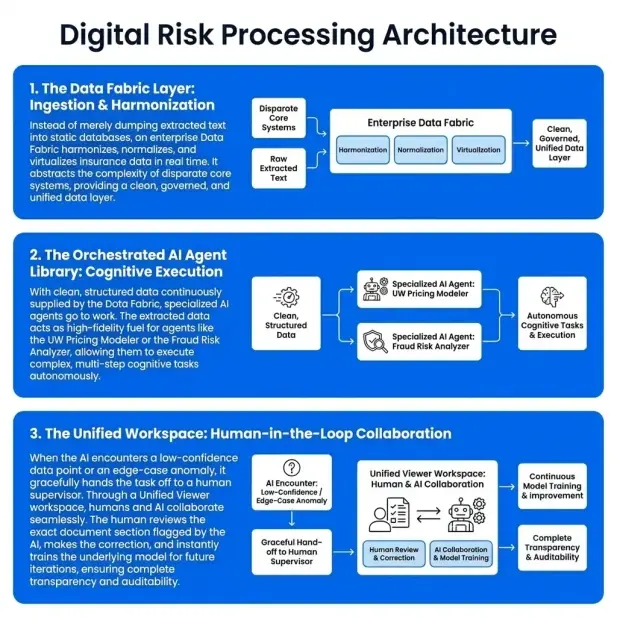
This full-stack approach relies on three deeply integrated architectural layers:
Real-world outcomes: Moving the enterprise needle
Transitioning from rigid, character-based OCR to a comprehensive, AI-driven data ecosystem yields massive, operational and financial metrics for global insurance enterprise carriers:
| Business Metric | Impact with Intelligent Automation | Strategic Enterprise Value |
| Operational Efficiency | Up to a 50% increase | Drastically reduces manual data processing costs and lowers overall operating ratios. |
| Time-to-Market | Up to 70% faster | Accelerates the ingestion and analysis of risk data, allowing rapid launch and pricing of new products. |
| Straight-Through Processing (STP) | 3x improvement in rates | Maximizes touchless claims and underwriting, leading to instant customer gratification. |
| Onboarding Efficiency | 60% reduction in onboarding time | Simplifies and accelerates broker and customer distribution journeys, maximizing premium retention. |
From intelligent submission intake to intelligent execution
Intelligent submission intake is no longer simply a document-processing capability. It is the foundational layer that enables insurers to move from fragmented workflows to autonomous operations.
As carriers seek to accelerate underwriting, improve claims outcomes, increase straight-through processing, and deliver more responsive customer experiences, the ability to transform unstructured information into intelligent action becomes a strategic advantage.
This requires more than standalone OCR, workflow automation, or isolated AI tools. It requires a unified operating model that connects data, decisions, systems, AI agents, and human expertise across the insurance value chain.
Neutrinos enables this vision through its Coreless System of Execution (CSoE), providing insurers with an intelligent execution layer that connects submission intake, document intelligence, workflow orchestration, decision automation, integrations, and AI-powered execution, without disrupting existing core systems.
By turning information into action and action into outcomes, Neutrinos helps insurers increase straight-through processing, accelerate underwriting and claims operations, reduce manual effort, and scale operational efficiency across the enterprise. The future of insurance is not simply digitized. It is autonomous. Connect with us to get started.
