
Coreless Execution Around Your Core Insurance Platform: Modernizing Engagement Without Replacing Policy and Claims Systems

For more than a decade, boards have heard one definition of insurance legacy modernization: rip out the core insurance platform and stand up a new policy administration system and claims engine in its place. The spend has been immense; the business impact, often less so — multi-year programs, real operational risk, and only incremental gains in the experiences agents and customers actually feel.
At the same time, AI, digital channels, and new distribution partnerships are resetting expectations. Agents want straight-through quotes, customers expect omnichannel service, and regulators demand transparent, auditable automation. That creates a paradox: you need speed and innovation at the edge, but the core was never built for real-time orchestration, data virtualization, or agentic AI.
What “coreless” really means (without losing your core)
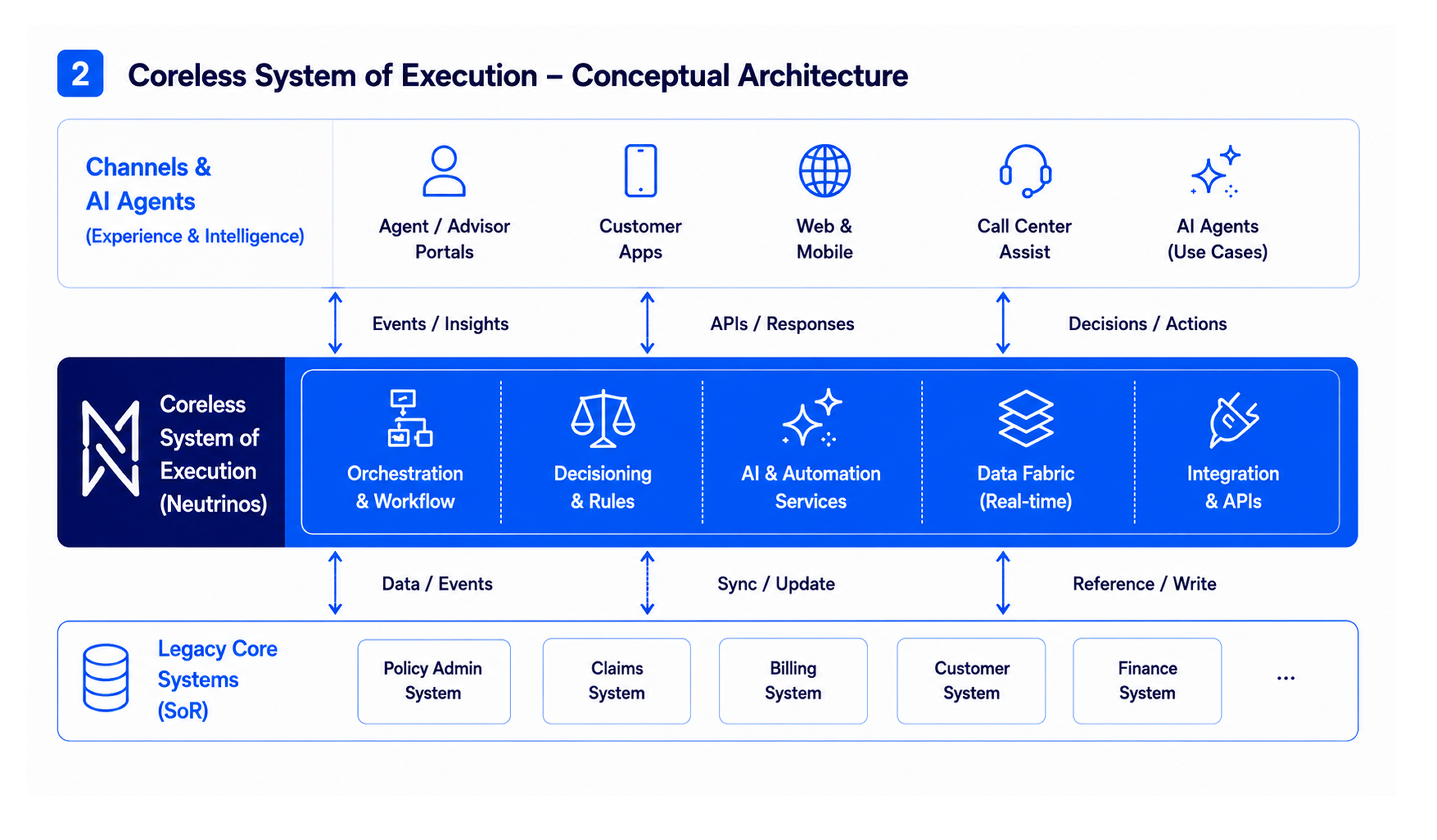
“Coreless” does not mean operating without a core system. It means not being constrained by one. In a coreless insurance architecture, your core insurance platform stays the system of record for policies, billing, and claims financials, but the business logic, workflows, and experiences are run in a separate insurance execution layer that sits above and around it.
That execution layer is built on data fabric, APIs, events, and orchestration rather than monolithic code. It abstracts the engagement and decisioning away from the core, so you can plug in AI, new journeys, and new distribution partners while the underlying legacy insurance systems keep doing what they do best: balancing the books and holding policy data consistent.
Decoupling the engagement layer from policy and claims systems
Most carriers now accept that they can’t afford “rip and replace” on every policy administration system they own, least of all across multi‑country, multi‑line portfolios. The smarter play is to decouple the engagement layer - customer apps, agent portals, partner APIs, and internal workbenches from the transactional core.
In practice, abstracting the insurance engagement layer comes down to three architectural moves:
- Virtualized data fabric: A governed data fabric layer sits between engagement and core, unifying policy, claims, billing, and external data into a single, real‑time view without copying everything into yet another data warehouse.
- API‑and event‑driven connectivity: A modern insurance API platform exposes core services - rating, coverage checks, claims FNOL, payment triggers - as APIs and events, so journeys can be composed without hard‑coding against the core.
- Externalized business rules: Rating, underwriting, claims routing, and communications logic move progressively into the execution layer, so “what happens next” is no longer locked inside mainframe code or legacy rules engines.
This is the essence of insurance core abstraction: the core remains your source of truth, but it stops being the place where every business decision has to be built, tested, and deployed.
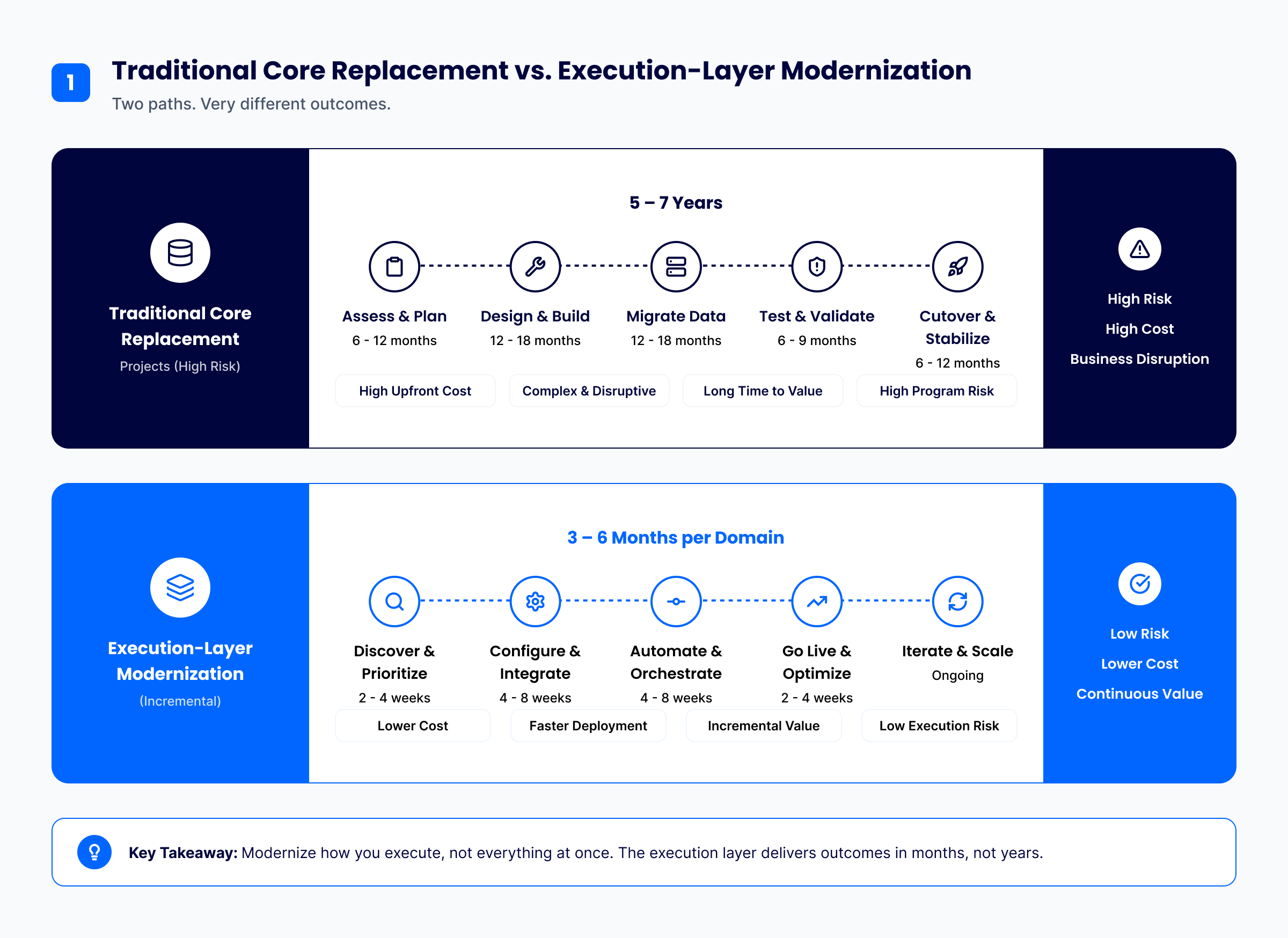
Core replacement Vs coreless execution layer?
A coreless system of execution changes the modernization debate from “Which new PAS should we buy?” to “Which capabilities should we externalize first?”
| Dimension | Traditional core replacement (new PAS) | Coreless execution layer on existing core |
| Primary goal | Replace legacy insurance systems entirely | Surround and abstract the core with a modern digital insurance platform |
| Time horizon | 3-7 years, multi‑wave rollout | 3-12 months per domain (claims, underwriting, distribution) |
| Risk profile | High operational risk; big‑bang cutovers | Progressive insurance platform modernization with reversible steps |
| Business focus | Internal systems capabilities | External experiences, AI decisions, and composable workflows |
| Cost model | Large capex, vendor replacement, data migration | Incremental capex/opex; leverage existing investments |
| Flexibility | New PAS can still become rigid over time | Built for composable insurance and plug‑and‑play solutions |
| Regulatory posture | Focus on core compliance | Added audit trails and lineage at the execution layer for automated decisions |
This reframing is powerful. Instead of betting everything on one new policy administration system, you assemble a set of composable capabilities such as data fabric, orchestration, agentic AI, and governance around the core. Over time, you can still retire or swap cores behind the execution layer, but that becomes an internal infrastructure project rather than a customer-visible transformation.
Why insurers need an execution layer in the AI era?
AI now sits at the center of underwriting triage, claims fraud detection, and customer interaction, yet most cores were never designed to feed agents fresh data, take their decisions in real time, or explain those decisions to regulators. An insurance execution layer solves this by acting as the operational “nervous system” that connects people, systems, and models.
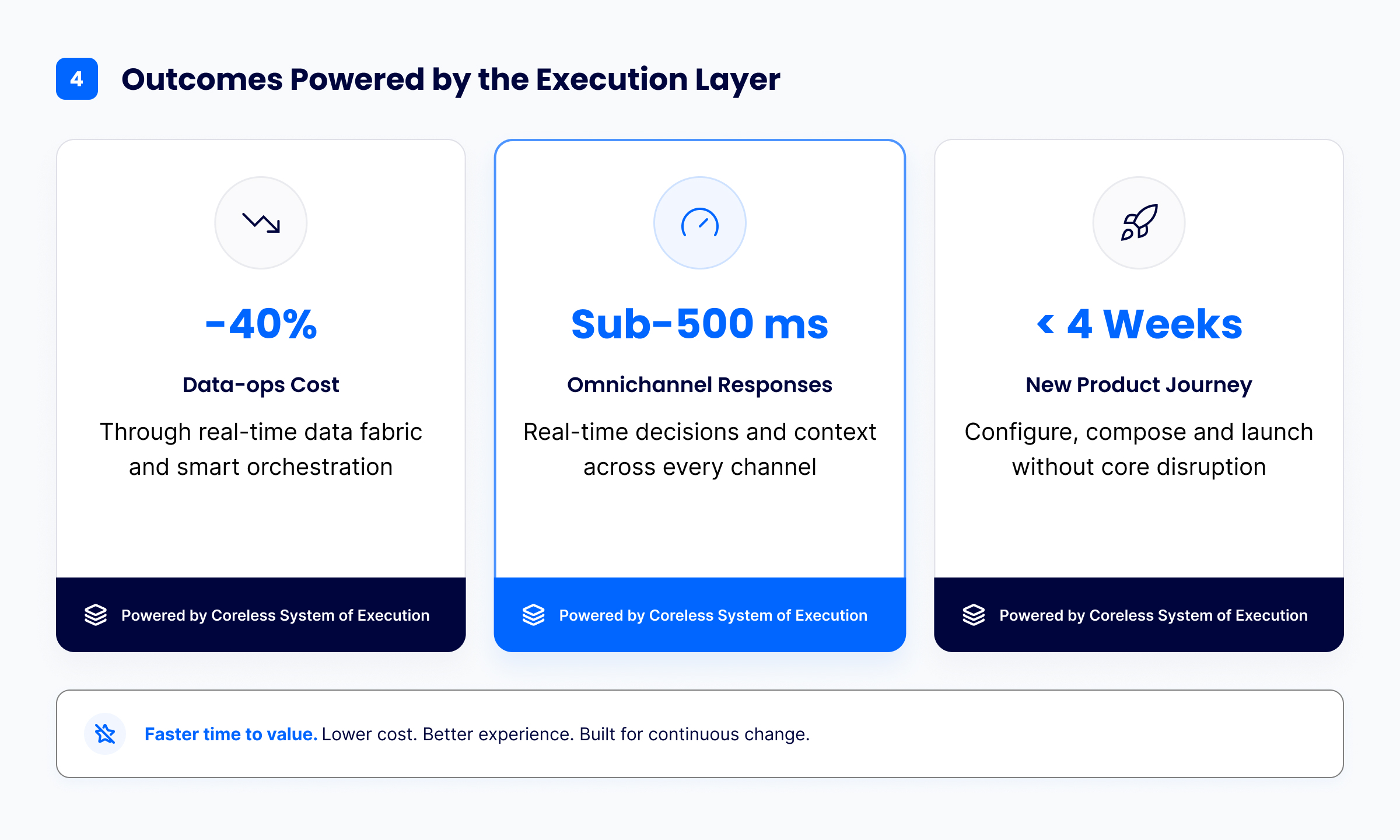
Neutrinos' AI-native Coreless System of Execution is one concrete example of the pattern. It combines a data fabric, event-driven architecture, agentic orchestration, and enterprise-grade governance, so insurers can run AI, automation, and digital workflows together without replacing their core systems. In production, carriers using this approach have cut data-operations costs by around 40 percent, delivered omnichannel interactions at sub-500-millisecond response times, and shipped new digital experiences in under four weeks.
Engagement‑led modernization: distribution, servicing, and claims first
A practical way to adopt coreless insurance architecture is to start where engagement pain is highest and core dependencies are strongest. For most insurers, that means three domains:
- Digital and embedded distribution: Agents, brokers, bancassurance partners, and ecosystems need fast, API-based access to quotes, pre-underwriting, and bind flows. Running these journeys in the execution layer lets you grow insurance digital distribution without exposing fragile core endpoints directly to outside parties.
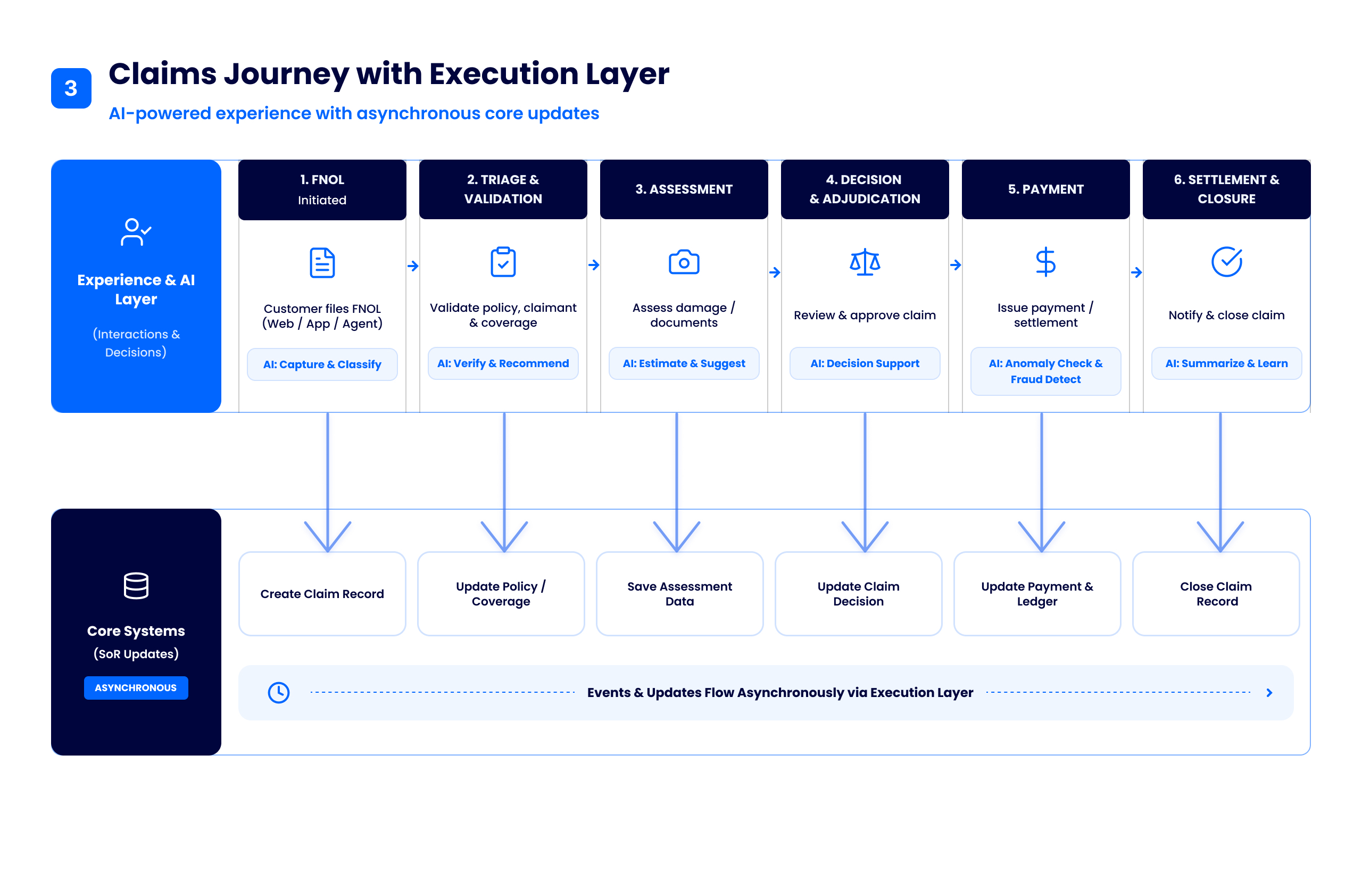
- Claims FNOL and servicing: Digital FNOL apps, omnichannel service, and proactive notifications sit naturally in the engagement layer. The execution layer orchestrates data pulls from claims cores, triage rules, and AI fraud signals, then pushes structured outcomes back to the core.
- Underwriting and new business: Medical data ingestion, risk scoring, and manual referral workflows can be composed on top of the data fabric and orchestration layer, using AI where appropriate and routing to human underwriters where required.
Because these journeys are built above the core, you can modernize them on a rolling basis - experimenting, A/B testing, iterating without destabilizing the underlying policy or claims engines. That's modernization measured in cycle-time reductions and straight-through-processing lift, not just project milestones.
Governance, audit, and explainability as first‑class citizens
As automation spreads across underwriting and claims, regulators are rightly focused on explainability, fairness, and control. A well‑designed insurance execution layer builds governance into the architecture rather than around it:
- Data lineage and policy‑based controls: Every data element used in a decision is tracked, with clear lineage from source to outcome.
- Tamper‑proof logs and audit trails: Automated decisions are logged immutably, making it possible to demonstrate compliance with regimes such as NAIC, PDPA, and MAS TRM.
- Separation of duties: Business users can manage rules and workflows at the execution layer, while core system changes remain under IT and architecture governance.
This is where legacy modernization in insurance parts ways with classic “upgrade the PAS” projects: governance sits at the same level as orchestration and AI, not bolted on afterward.
Neutrinos’ AI‑native Coreless System of Execution embodies this approach, giving insurers a way to run AI, automation, and digital workflows together without replacing their core systems. To see how this pattern looks in detail, you can explore the Coreless System of Execution solution overview and map that architecture against your own modernization roadmap and constraints. In doing so, modernization stops being synonymous with core replacement. It becomes a disciplined shift of business execution like how you engage, decide, and serve from the core to an agile, governed layer that’s built for the AI era.
If you’d like to see how a coreless insurance architecture and insurance execution layer could work with your existing core insurance platform, you can book a demo with the Neutrinos team to walk through real implementation patterns and impact data.
Ready to explore this for your stack? Book a demo.
Frequently asked questions
A single new front end usually creates point‑to‑point integrations and brittle dependencies on specific core releases. A true digital insurance platform built as a coreless insurance architecture introduces shared services such as data fabric, orchestration, rule engines and AI connectors that can be reused across lines and channels. Instead of each app talking directly to the PAS, they talk to the execution layer, which handles insurance core abstraction for them.
Yes, over time you will still refresh or consolidate cores; however, the architectural priority shifts. You first focus on building the execution layer and abstracting policy logic through APIs, events, and externalized rules, what you might call abstract policy administration. Once that is in place, you can swap out cores behind the scenes with far less disruption to customers, agents, or partners.
Coreless is an execution‑layer expression of composability. Microservices, APIs, and event streams are used to break journeys into modular components that can be recombined across products, geographies, and channels, aligning closely with composable insurance thinking. The execution layer ensures those services are governed, observable, and orchestrated coherently, rather than becoming a sprawl of uncoordinated micro‑apps.
No. Regional and mid‑size carriers face similar constraints: they may have fewer systems but still need to move faster than core upgrades allow. For them, a coreless execution layer is a way to achieve insurance platform modernization without immediately embarking on multi‑year, multi‑core replacement projects. Even a single‑core environment benefits from an execution layer that handles engagement, AI, and orchestration centrally.
For CIOs, CTOs, and heads of transformation, the question is no longer whether to modernize, only how. Building a coreless insurance architecture with a dedicated insurance execution layer offers a pragmatic path:
- Use your existing core insurance platform as the system of record, not as the system of innovation.
- Surround it with execution‑layer capabilities: data fabric, APIs, events, orchestration, AI connectors, and governance.
- Prioritize journeys where engagement pain and AI opportunity are highest such as claims, underwriting, insurance digital distribution, etc. and modernize them first.
